News Message
Two Cylinder Stirling Engine
- by wittx 2022-11-16
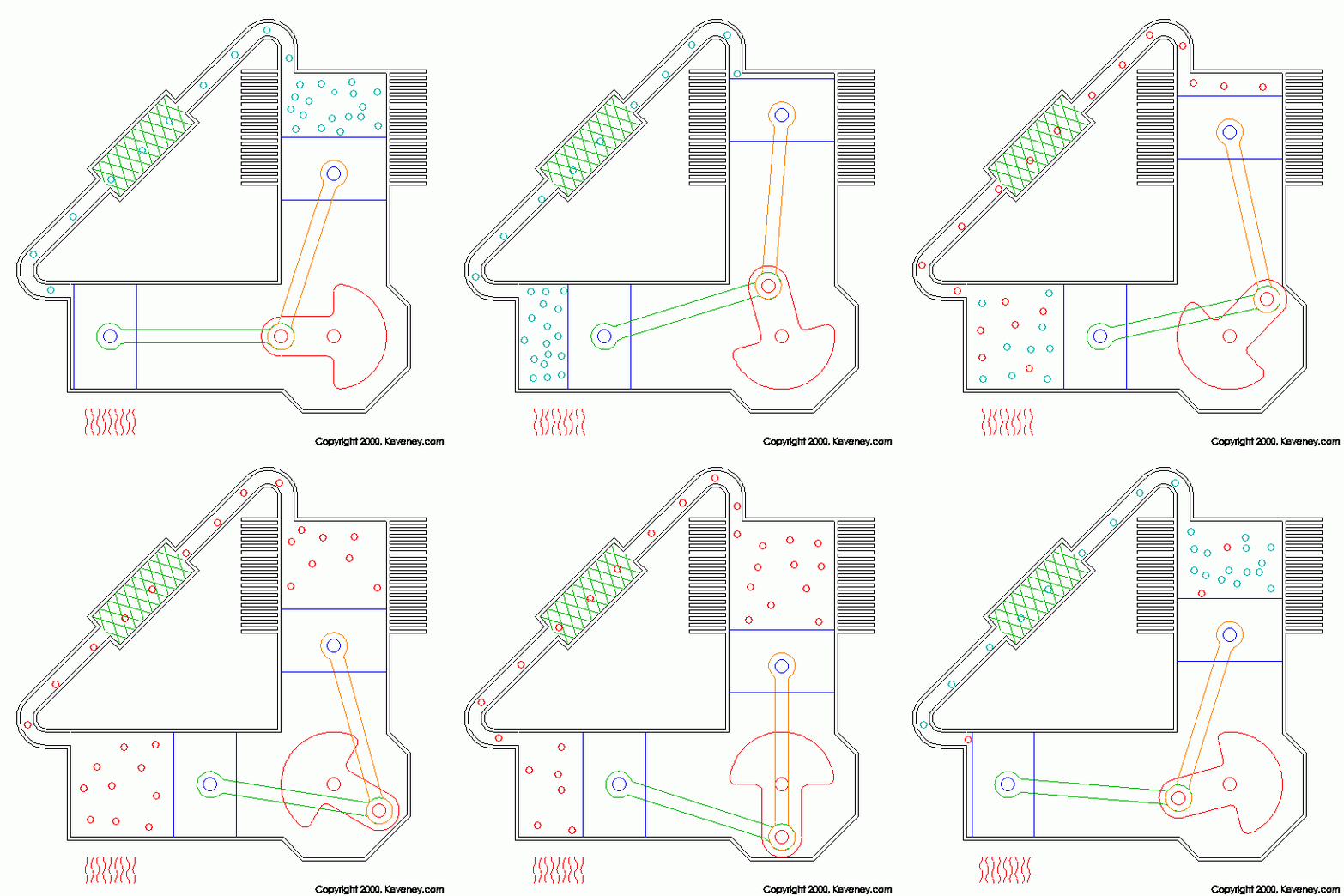
| The Stirling engine is one of my favorites. It was invented in 1816 by Rev. Robert Stirling of Scotland. The Stirling is a very simple engine, and was often billed as a safe alternative to steam (since there’s no boiler to explode). It enjoyed some success in industrial applications, and in small appliances like fans and water pumps, but was eclipsed by the advent of inexpensive electric motors.3 Since it can run on any source of heat, it now holds promise for alternative fuel engines, solar power, geothermal power, etc. | |
 | |
| Stirling engines feature a completely closed system in which the working gas (usually air but sometimes helium or hydrogen) is alternately heated and cooled by shifting the gas to different temperature locations within the system. In the two-cylinder or alpha configured3 The Stirling cycle may be thought of as four different phases: | |
| Expansion. At this point, most of the gas in the system has just been driven into the hot cylinder. The gas heats and expands driving both pistons inward. |  |
| Transfer. At this point, the gas has expanded (about 3 times in this example). Most of the gas (about 2/3rds) is still located in the hot cylinder. Flywheel momentum carries the crankshaft the next 90 degrees, transferring the bulk of the gas to the cool cylinder. |  |
| Contraction. Now the majority of the expanded gas has been shifted to the cool cylinder. It cools and contracts, drawing both pistons outward. |  |
| Transfer. The now contracted gas is still located in the cool cylinder. Flywheel momentum carries the crank another 90 degrees, transferring the gas to back to the hot cylinder to complete the cycle. |  |
| This engine also features a regenerator, illustrated by the chamber containing the green hatch lines. The regenerator is constructed of material that readily conducts heat and has a high surface area (a mesh of closely spaced thin metal plates for example). When hot gas is transferred to the cool cylinder, it is first driven through the regenerator, where a portion of the heat is deposited. When the cool gas is transferred back, this heat is reclaimed; thus the regenerator „pre heats“ and „pre cools“ the working gas, dramatically improving efficiency.3 | |
Share Http URL: http://www.wittx.cn/get_news_message.do?new_id=1024


Best Last Month

Information industry
by wittx

Office culture and education
by wittx
Information industry
by wittx
Information industry
by wittx
Chameleon: Plug-and-Play Compositional Reasoning with Large Language Models

Information industry
by wittx
Information industry
by wittx
Information industry
by wittx
Medical science
by wittx

Information industry
by wittx